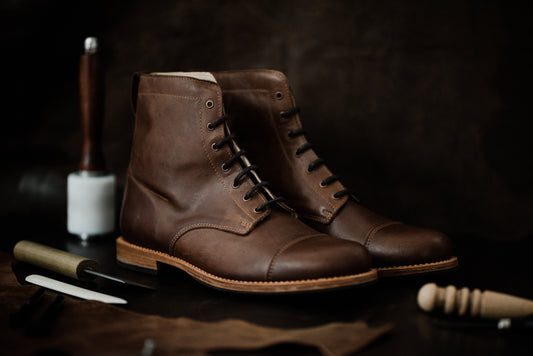

Handmade Boots vs Mass Production: What You’re Really Paying For
Aktie
Handmade Boots vs Mass Production: What You’re Really Paying For
At a glance, handmade boots and mass-produced boots can look surprisingly similar. Leather uppers, clean stitching, solid soles.
That surface similarity is exactly why many buyers struggle to understand the price difference.
The reality is simple: these two types of boots are designed around completely different priorities.
Mass Production Is Optimised for Speed
Mass-produced footwear is built to move quickly through factories. Every step is measured in seconds.
To achieve this, production relies on:
- Standardised sizing and shapes
- Adhesive-based sole attachment
- Split or corrected leathers that are easy to handle
- Minimal manual intervention
These choices reduce cost and increase volume. They also reduce longevity.
When wear appears, replacement is expected. Repair is rarely part of the equation.
Handmade Boots Are Optimised for Time
Handmade boots operate on a different axis entirely. The goal is not speed, but endurance.
Time is invested where it matters:
- Selecting full-grain leather that ages well
- Stitched construction that allows resoling
- Manual inspection at every stage
- Adjustments based on material behaviour
This approach costs more upfront, but dramatically changes how the boot behaves over years of wear.
Labour: The Invisible Line Item
In mass production, labour is minimised. Workers perform narrow, repetitive tasks.
In handmade production, labour is the product. Skilled hands cut, stitch, shape and finish each component.
That skill cannot be automated or rushed. It is also what allows boots to be repaired, adjusted, and kept in use instead of discarded.
Why Repairability Changes the Value Equation
Most buyers compare boots at the moment of purchase. That comparison is incomplete.
The real comparison happens years later:
- Has the sole worn through?
- Can it be replaced?
- Does the upper still hold its shape?
Mass-produced boots usually exit the picture here. Handmade boots enter a maintenance cycle instead.
This single difference often determines whether a boot lasts one year or ten.
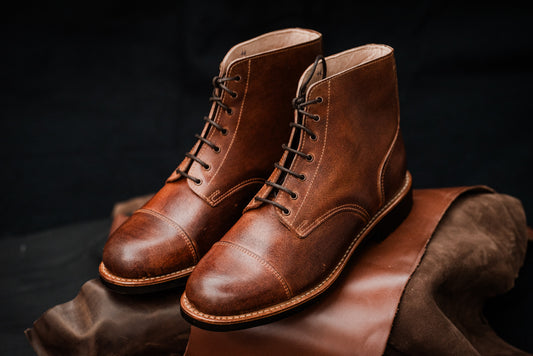
Handmade boots designed for long-term ownership:
Built with stitched construction and quality leather, designed to be repaired rather than replaced.
Materials: Appearance vs Behaviour
Lower-grade leathers are often treated to look uniform and flawless. They photograph well and feel soft initially.
Over time, they crack, dry out or lose structure.
Full-grain leather behaves differently. It develops patina, adapts to the foot, and strengthens with care.
This behaviour is invisible on day one and decisive after several years.
Why the Price Difference Exists
When you pay more for handmade boots, you are not paying for a logo or a trend.
You are paying for:
- Time invested instead of time saved
- Materials chosen for ageing, not speed
- Construction that anticipates repair
- Reduced replacement over a lifetime
Seen through this lens, handmade boots are not expensive. They are deliberate.
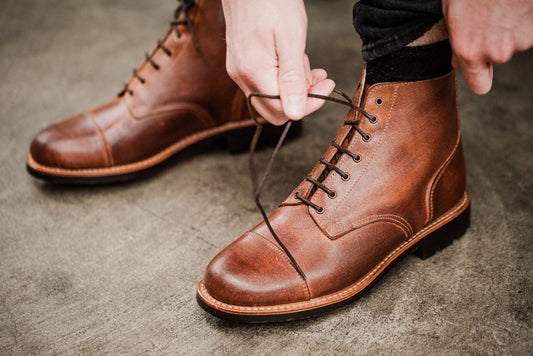
Boots built around durability, not volume:
Designed for people who value long-term use over short-term savings.
The Real Question Behind Every Purchase
The real question isn’t “Why are handmade boots more expensive?”
It’s “Why are mass-produced boots replaced so quickly?”
Once that question is answered, the price difference stops being confusing.